
The first time you see your baby’s arms suddenly fling out when they hear a loud noise, your heart might skip a beat. Is something wrong? Should you call the doctor? You pick up your little one, and those tiny fingers wrap around yours with a grip that surprises you. Then, when you stroke your baby’s cheek while trying to feed, their head turns toward your touch like they know exactly what to do.
These aren’t random movements. They’re called Primitive Reflexes in Newborns, and they’re actually a sign that your baby’s nervous system is doing exactly what it should.
What Are Primitive Reflexes in Newborns?
When your baby is born, their brain isn’t quite ready to control all their movements yet. That’s where these reflexes come in. Think of them as your baby’s built-in survival toolkit. Primitive Reflexes in Newborns are involuntary motor responses that happen without your baby thinking about them. They start in the brainstem and help your little one do things they need to do before their brain fully develops.
Your baby didn’t learn these movements. They came with them. Some of these reflexes even started working before birth, when your baby was still inside you.
Most of these reflexes will fade away between 4 to 6 months as your baby’s development progresses. When that happens, your baby will start making more purposeful, controlled movements instead of just reacting automatically.
The Main Reflexes You’ll See (And What They Mean)
Rooting and Sucking
You touch your baby’s cheek, maybe by accident while holding them, and suddenly their head turns toward your hand. Their mouth opens, searching for something. This is the rooting reflex, and it’s beautiful to watch because it shows how your baby knows how to look for food.
The sucking reflex goes hand in hand with this. Put your clean finger or a nipple in your baby’s mouth, and they’ll start sucking. Your baby has been practicing this since around 14 weeks in the womb. For babies born early, this reflex might be weaker because they didn’t have as much time to develop it.
These reflexes usually stick around until your baby is about 4 months old, though you might see them pop up during sleep even at 8 months. If you’re struggling with feeding, you might want to read more about breastfeeding basics every new mom should know.
What if it’s missing? If your baby doesn’t seem interested in feeding or can’t coordinate sucking, breathing, and swallowing, that might signal a problem with brain development. Your doctor will check for this during your newborn’s first checkups.
The Moro Reflex (Startle Response)
This one catches almost every new parent off guard. You’re holding your sleeping baby, and a door slams. Suddenly, your baby’s arms shoot out, legs extend, fingers spread wide, and then everything pulls back in with a cry.
The Moro reflex is your baby’s alarm system. When they feel like they’re falling or hear something loud, their body reacts. Some doctors test this by gently supporting your baby’s head and shoulders, then letting the head drop back just a little bit while still supporting it.
What should happen? Both sides of your baby’s body should react the same way. Arms and legs extend, then pull back in. If one side moves differently than the other, that could mean there’s an injury to that arm or leg.
This reflex normally disappears by around 4 to 6 months. If it’s still happening after that, you should mention it to your pediatrician. Sometimes what looks like a Moro reflex in older babies is actually something else, like infantile spasms, which needs treatment.
For premature babies: The Moro reflex might be weaker because preemies have lower muscle tone. That’s normal for them, but it’s something doctors watch closely.
Grasp Reflex
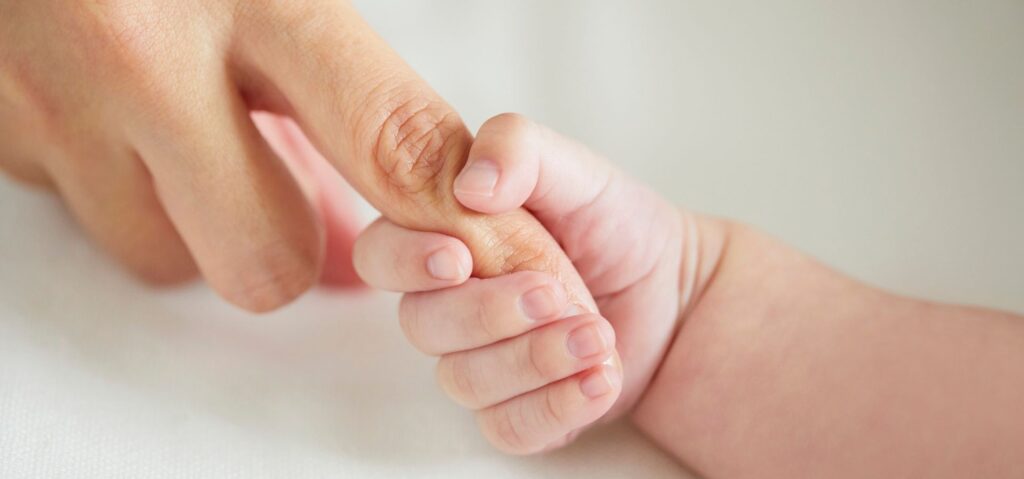
Press your finger into your baby’s palm. Feel that? Those tiny fingers curl around yours and hold on tight. It’s one of the most heart-melting moments of new parenthood.
The grasp reflex appears by 28 weeks of pregnancy, so even babies born very early will have it. It’s so strong that some newborns can actually support their own weight briefly if they’re gripping your fingers with both hands. Not that you should try this, of course.
This reflex goes away around 5 to 6 months for the hands. Your baby’s feet have a similar reflex that lasts a bit longer, until about 9 to 12 months. Once this reflex fades, you’ll start to see more intentional developmental milestones emerge.
If the grasp reflex is weak or missing on one side, it might mean there’s an injury to the nerves in that arm.
Babinski Reflex (Plantar Response)
Run your finger firmly up the outside of your baby’s foot, from heel to toe, curving toward the big toe. Your baby’s big toe will bend upward and back, and the other toes will fan out. In adults, this would be a warning sign of something wrong with the nervous system. But in babies? It’s completely normal.
The Babinski reflex shows that your baby’s nervous system is still developing. It should be there from birth until your baby is about 1 to 2 years old. After that, if you stroke their foot, the toes should curl down instead.
If the Babinski reflex is absent in a young baby, that’s actually more concerning than having it. And if it’s still there after age 2, that might mean there’s a problem with the upper motor neurons in the brain.
Stepping Reflex
Hold your baby upright with their feet touching a surface, and they’ll start moving their legs like they’re walking. It looks like your baby is already trying to take their first steps, but don’t get too excited. They can’t support their own weight yet, and this is just a reflex.
The stepping reflex shows up in the first 6 weeks of life and then disappears by about 2 months. It won’t come back until near the end of your baby’s first year when they’re actually learning to walk for real.
Tonic Neck Reflex (The Fencing Position)
Turn your baby’s head to one side while they’re lying on their back. The arm on the side they’re facing will stretch out, while the opposite arm bends at the elbow. Your baby looks like a little fencer ready for a match.
This reflex helps your baby develop the range of motion they’ll need later for rolling over, crawling, and walking. It usually fades by 4 to 6 months.
If this reflex comes back later in life, it’s not a good sign. It might indicate serious brain problems.
When Reflexes Tell a Different Story
These reflexes aren’t just cute baby tricks. Doctors use them to check how your baby’s nervous system is developing, which is why newborn health screenings are so important.
In healthy full-term babies, strong reflexes that appear and disappear on schedule are a good sign. When doctors test these reflexes at your baby’s checkups, they’re looking for:
- Are the reflexes present when they should be?
- Are they strong enough?
- Do both sides of the body react the same way?
- Do they fade away at the right time?
In premature babies, reflexes might develop after birth based on how early they were born. A baby born at 32 weeks might not have a strong sucking reflex yet, even though they’re now two weeks old. That’s because they would only be 34 weeks in gestational age.
Warning signs that something might be wrong:
- A reflex that should be there is completely missing
- One side of the body reacts differently than the other
- A reflex is much weaker or stronger than it should be
- A reflex that should have disappeared is still present months later
Research shows that when 5 or more reflexes are abnormal, there’s a higher chance of cerebral palsy or developmental delays. But finding one absent or unusual reflex doesn’t mean your baby will have problems. Sometimes babies just develop on their own timeline.
What This Means for Premature or High-Risk Babies
If your baby was born early, had a difficult delivery, or spent time in the NICU, their reflexes might look different. Understanding what parents should know about newborn jaundice and other common concerns can help you navigate this period.
Studies of high-risk newborns show that these babies often have:
- Weaker reflexes overall
- Reflexes that are absent when they should be there
- Reflexes that develop later than expected
The good news? Doctors know to watch for this. If your baby is in the NICU, the medical team is checking these reflexes regularly. They’re tracking how your baby’s nervous system is maturing.
One study published in the Journal of Clinical Medicine looked at 67 high-risk newborns and found that the sucking reflex was most likely to be normal (about 64% of babies), followed by the Babinski reflex (59%), and then the Moro reflex (43%). This shows that different reflexes develop at different rates, even in babies who need extra medical support.
Living with These Reflexes: What You Can Do
You can’t control these reflexes, and you don’t need to practice them or try to make them stronger. They’re automatic. But understanding them can make life with your newborn easier.
For the Moro reflex: This is the one that wakes up your baby constantly. You finally get them to sleep, you put them down in the crib, and boom, arms fly out, baby’s crying. Safe swaddling techniques can help. When your baby’s arms are wrapped snugly, they can’t fling them out as much. Just make sure their hips can still move freely. Stop swaddling once your baby starts trying to roll over.
For feeding reflexes: Don’t worry if your baby is sucking on their hands right after eating. The sucking reflex can kick in even when they’re not hungry. It’s actually a way your baby soothes themselves. Some parents panic and think their baby is still hungry, so they feed them more, and then the baby spits up because they’re too full. Learn more about formula feeding practices if you’re bottle feeding.
For the startle reflex: If your baby startles at every little sound, create a quieter environment. White noise can help mask sudden noises. During diaper changes, support your baby’s head so they don’t feel like they’re falling. Speaking of which, here are some practical tips for diaper changing.
General tips:
- Talk to your baby calmly during activities that might trigger reflexes
- Support their head and body when moving them
- Keep lights dimmer during nighttime activities
- Don’t try to test these reflexes yourself repeatedly
If you’re feeling overwhelmed by all these new parent responsibilities, remember that postpartum recovery takes time and it’s okay to ask for help.
Questions Parents Ask
Q: My baby keeps hitting themselves in the face. Is this normal?
Yes. Because of the Moro reflex and general jerky movements, babies often smack themselves. Mittens or long-sleeved onesies that cover their hands can help if it’s bothering them or scratching their face.
Q: One arm looks weaker when my baby startles. Should I worry?
An asymmetric Moro reflex (when one side reacts differently) could mean an injury to that arm, shoulder, or collarbone. Sometimes babies get these injuries during a difficult delivery. Tell your doctor right away.
Q: My 7-month-old is still startling a lot. Is something wrong?
The Moro reflex should be gone by 6 months. If your baby is still having these dramatic startle responses, talk to your pediatrician. It might not be the Moro reflex anymore and could need evaluation.
Q: My baby doesn’t seem to have a rooting reflex. What now?
Some babies, especially those born very early, have weak feeding reflexes. Your doctor or a lactation consultant can help. There are ways to support feeding until your baby’s reflexes strengthen.
Q: Can these reflexes hurt my baby?
The reflexes themselves don’t hurt. But if they’re very strong or don’t integrate properly, they can make life uncomfortable. Babies with a strong Moro reflex might not sleep well. Babies with persistent reflexes might have trouble with motor skills later. For help with sleep issues, check out this guide on safe bathing tips for newborns which can be part of a calming bedtime routine.
What Happens When Reflexes Don’t Go Away
In most babies, these primitive reflexes fade naturally as the brain matures. The front part of the brain takes over and starts controlling movements more precisely.
But sometimes reflexes stick around longer than they should. When this happens past 6 months, it’s called retained primitive reflexes. Research suggests this can affect:
- Motor development (crawling, walking, coordination)
- Balance and posture
- Hand-eye coordination
- Reading and writing later on
- Attention and focus
Why do reflexes sometimes persist? Possible reasons include:
- Cesarean delivery (no birth canal stimulation)
- Lack of tummy time
- Skipping the crawling stage
- Head injuries
- Chronic ear infections
- Premature birth
If you’re worried about your child’s development, talk to your pediatrician. Some therapists specialize in helping children integrate these reflexes through specific exercises and activities.
The Bigger Picture
Primitive Reflexes in Newborns are your baby’s first communication with the world. Before they can tell you what they need, before they can reach for you deliberately, these reflexes keep them safe and help them survive.
When you understand what’s happening, you can respond better. That startle doesn’t mean your baby is scared of you. That hand-to-mouth movement doesn’t always mean hunger. That grip on your finger is just their body doing what it’s programmed to do.
Every baby develops at their own pace. Some reflexes might be stronger. Some might fade earlier or later. That’s okay. Your baby is unique.
What matters is keeping track of the big picture. Are most of the reflexes there? Are they relatively strong? Do they seem to be fading as your baby gets older? If yes to all three, you’re probably doing just fine.
Trust your instincts. You know your baby better than anyone else. If something feels off, if a reflex seems too strong or too weak, if your baby isn’t meeting milestones, speak up. That’s what pediatricians are for. They want to hear your concerns.
These early months fly by. Before you know it, your baby will be reaching for you on purpose, not just grabbing reflexively. They’ll smile at you because they recognize you, not because it’s an automatic response. They’ll walk toward you deliberately.
But right now, in these early weeks, these primitive reflexes are doing their job. They’re keeping your baby alive, helping them eat, protecting them from danger, and laying the groundwork for all the amazing development that’s coming.
So the next time those little fingers wrap around yours, take a moment. It might be just a reflex, but it’s also a miracle. Your baby’s brain is working exactly the way it should, guiding them through these first crucial months of life.
Need More Help?
For instant answers to your parenting questions any time of day, visit Is My Baby Alright for trusted, safe guidance on newborn care, feeding, sleep, and development.
More Resources on Newborn Care:
- How to Know If Your Baby’s Crying Is Normal
- Baby Sleep Guide: Schedules from 0 to 12 Months
- Essential Newborn Care: What Every New Parent Needs to Know
External Medical Resources: